
Yomovies Online Movie __link__ -
YoMovies have emerged, catering to a global audience hungry for diverse content. While such sites offer unparalleled accessibility to Hollywood, Bollywood, and regional films, they also sit at the center of a complex debate regarding digital ethics, accessibility, and the future of the film industry. A Gateway to Global Content One of the most significant draws of YoMovies is its vast and diverse library. Unlike many mainstream streaming services that are region-locked or limited by licensing agreements, YoMovies often provides a "one-stop-shop" experience. For fans of South Asian cinema living abroad, or Western viewers looking for niche international titles, the platform provides a bridge to cultures and stories that are otherwise difficult to access. This democratization of content allows films to reach audiences far beyond their intended geographical borders, fostering a more globalized film culture. The Convenience of Modern Consumption The platform’s popularity is largely driven by its user-centric design. In an era of "subscription fatigue"—where users are often required to pay for five or six different services to see their favorite shows—YoMovies offers a streamlined, cost-free alternative. The ability to stream high-definition content instantly, often without the need for complex registration or high-cost hardware, aligns with the modern consumer's desire for "on-demand" gratification. The Ethical and Legal Paradox However, the convenience of YoMovies comes with significant ethical baggage. As a third-party streaming site, it often operates outside of traditional copyright laws. This creates a parasitic relationship with the film industry: while it provides viewers with free entertainment, it simultaneously diverts revenue away from the creators, actors, and studios who invested millions into production. For independent filmmakers, this "free" access can be particularly devastating, as every pirated view represents a lost sale that could have funded their next project. Security and the User Experience Beyond the legalities, there is the practical concern of digital safety. Unlike official platforms like
| Step | What Happens | Technical Highlights | |------|--------------|----------------------| | | • User clicks “Start Watch‑Party”. • Generates a shareable link or QR code. • Option to make it public (open to any Yomovies member) or private (invite‑only). | • WebRTC‑based low‑latency sync (audio/video timestamps shared via a small signaling server). • Token‑based authentication for secure invites. | | B. AI‑Driven Pre‑Play Intro | • 30‑second AI‑generated trailer remix that highlights the movie’s most talked‑about moments, using publicly available data (e.g., IMDB, Rotten Tomatoes). • Optional “Quick‑Pitch” voice‑over summarizing the plot. | • Text‑to‑speech (TTS) model for narration. • Video‑clip extraction API (leveraging public domain or licensed clips). | | C. Synchronized Playback | • All participants see the exact same frame at the same time. • “Pause‑for‑All” or “Leader‑only control” options. | • Adaptive buffering algorithm that compensates for differing network speeds. | | D. Real‑Time Interactive Layers | 1. Live Trivia Pop‑ups – Every 5–10 min, a small overlay asks a question about the scene. 2. Scene‑Summaries – Hover‑or‑tap a “i” icon to see a 2‑sentence AI‑generated recap. 3. Language‑Learn Mode – Dual subtitles (original + target language) with click‑to‑define vocabulary. 4. Mood‑Music Queue – AI suggests background playlists based on current scene tone (e.g., “tense”, “romantic”). | • NLP models for question generation (GPT‑style). • Summarization pipeline (extractive + abstractive). • Subtitle‑overlay engine that can sync two subtitle tracks. • Audio‑analysis to detect emotional cues (tempo, key, amplitude). | | E. Social Reactions | • Emoji reactions that float briefly on screen (e.g., “😂” for a funny line). • Real‑time chat panel with optional “auto‑translate”. | • WebSocket channel for low‑latency chat. • Translation APIs (e.g., DeepL, Google Translate) for multilingual groups. | | F. Post‑Party Highlights | • Auto‑generated “Party Recap” video (30 sec) containing top trivia scores, most‑liked moments, and a short “what‑you‑missed” clip. • Shareable on social media. | • Video‑editing micro‑service that stitches clips, overlays text, and adds background music. • Direct API hooks to Twitter, Instagram, TikTok. | yomovies online movie
Please note that while we strive to provide a seamless streaming experience, some movies may be removed due to copyright issues. We encourage users to support the film industry by watching movies through official channels. YoMovies have emerged, catering to a global audience
“Watch‑Together + AI‑Enrich” lets users start a synchronized streaming session with friends or the broader community, while an AI engine adds real‑time, context‑aware overlays: trivia, scene‑summaries, language‑learning subtitles, and even dynamic mood‑based playlists. while an AI engine adds real‑time
Watch Your Favorite Movies Online at Yomovies!
eFatigue gives you everything you need to perform state-of-the-art fatigue analysis over the web. Click here to learn more about eFatigue.
Yomovies Online Movie __link__ -
Welds may be analyzed with any fatigue method, stress-life, strain-life or crack growth. Use of these methods is difficult because of the inherent uncertainties in a welded joint. For example, what is the local stress concentration factor for a weld where the local weld toe radius is not known? Similarly, what are the material properties of the heat affected zone where the crack will eventually nucleate. One way to overcome these limitations is to test welded joints rather than traditional material specimens and use this information for the safe design of a welded structure.
One of the most comprehensive sources for designing welded structures is the Brittish Standard Fatigue Design and Assessment of Steel Structures BS7608 : 1993. It provides standard SN curves for welds.
Weld Classifications
For purposes of evaluating fatigue, weld joints are divided into several classes. The classification of a weld joint depends on:
- the macroscopic geometry of the pieces welded,
- the direction of the cyclic stresses, and
- the location of the crack that leads to failure.
Two fillet welds are shown below. One is loaded parallel to the weld toe ( Class D ) and the other loaded perpendicular to the weld toe ( Class F2 ).
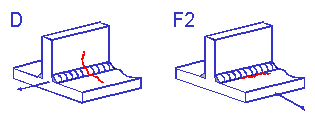
It is then assumed that any complex weld geometry can be described by one of the standard classifications.
Material Properties
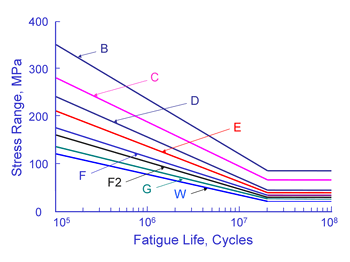
The curves shown above are valid for structural steel welds. Fatigue lives are not dependant on either the material or the applied mean stress. Welds are known to contain small cracks from the welding process. As a result, the majority of the fatigue life is spent in growing these small cracks. Fatigue lives are not dependant on material because all structural steels have about the same crack growth rate. The crack growth rate in aluminum is about ten times faster than steel and aluminum welds have much lower fatigue resistance. Welding produces residual stresses at or near the yield strength of the material. The as welded condition results in the worst possible residual or mean stress and an external mean stress will not increase the weld toe stresses because of plastic deformation. Fatigue lives are computed from a simple power function.

The constant C is the intercept at 1 cycle and is tabulated in the standard. This constant is much larger than the ultimate strength of the material.
The standard is only valid for fatigue lives in excess of 105 cycles and limits the stress to 80% of the yield strength. Experience has shown that the SN curves provide reasonable estimates for higher stress levels and shorter lives. In eFatigue, the maximum stress range permitted is limited by the ultimate strength of the material for all weld classes.
Design Criteria
Test data for welded members has considerable scatter as shown below for butt and fillet welds.
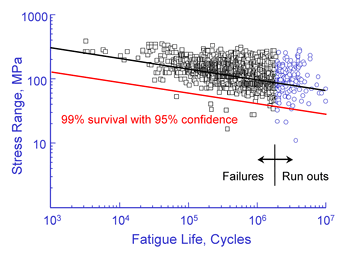
Some of this scatter is reduced with the classification system that accounts for differences between the various joint details. The standard give the standard deviation of the various weld classification SN curves.
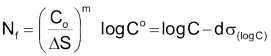
The design criteria d is used to determine the probability of failure and is the number of standard deviations away from the mean. For example d = 2 corresponds to a 2.3% probability of failure and d = 3 corresponds to a probability of failure of 0.14%.
© 2026 Western Nest Co. All rights reserved.